
When To Start Sleep Training: Signs Your Baby Is Ready



How do you know when to start sleep training your baby, what sleep training actually means, and what approach is right for your child?
One of the most common questions parents ask is when to start sleep training baby or what age to start sleep training.
Some families start searching because their baby is waking every one to two hours overnight. Others are dealing with short naps, bedtime battles, false starts, early morning waking, or a baby who needs a lot of support to fall asleep.
You might be wondering:
What is sleep training?
When do you start sleep training?
When to start sleep training a baby?
How to start sleep training?
Which sleep training methods are right for my baby?
The truth is, there is not one perfect age or one perfect method that suits every baby.
Baby sleep training depends on your child’s age, development, temperament, feeding needs, sleep environment, routine and what feels realistic for your family.
This guide will help you understand what sleep training is, when your baby may be ready, what to consider before starting, and how sleep training can look different depending on your baby or toddler’s stage.
What is sleep training?
Sleep training is the process of helping your baby or toddler move toward more independent sleep, in a way that matches their age, development, temperament and family needs.
For some families, baby sleep training means helping their baby fall asleep independently at bedtime. For others, it means reducing frequent night waking, improving short naps, supporting self-settling, changing how they respond overnight, or creating more predictable routines.
Sleep training does not have to mean one method.
It can include a full range of sleep training methods, from very gradual, hands-on approaches through to more structured out-of-room approaches, depending on your child’s age, temperament and what you feel comfortable with.
At The Sleepy Little Bubs, sleep training is never about forcing a baby to sleep or ignoring genuine needs. It is about understanding the full sleep picture and choosing a consistent approach that supports your child to fall asleep with less help over time.
That means looking at:
Sleep environment
Routine and awake windows
Nap timing and nap length
Feeding patterns
Night wakes
Settling approach
Developmental stage
Temperament
Parent preferences
What is sustainable for the family
When people ask what is sleep training a baby, this is the most important thing to understand. It is not just about the settling technique. The technique is only one part of the plan.
Is there a minimum age for sleep training?
Formal sleep training is generally not recommended until 4 months of age.
In the early months, frequent waking, feeding overnight, contact naps, short naps and needing support to settle are all biologically normal.
While some families talk about sleep training from four months, I generally prefer to wait until around five months for more structured sleep training, once sleep cycles have matured further and babies are more developmentally ready for longer stretches of sleep.
Before this age, the focus is usually on sleep education, realistic expectations, feeding, routine support and creating a safe, sleep-conducive environment.
For babies under five months, sleep support may include:
Understanding normal newborn and infant sleep
Creating gentle rhythm across the day
Supporting age-appropriate awake windows
Establishing a predictable bedtime routine
Reviewing feeding and daytime intake
Creating a safe sleep environment
Supporting naps without expecting perfection
Helping parents understand what is normal for their baby’s age
This is not the same as formal sleep training. It is sleep support.
What if my baby is under five months?
If your baby is under five months, it does not mean there is nothing you can do.
It simply means the approach needs to match their age and development.
At this stage, sleep challenges are often linked to immature sleep cycles, feeding needs, reflux or discomfort, short awake windows, overtiredness, day sleep structure, or the normal neurological changes that happen around the four month stage.
Many families at this age are also navigating the 4 Month Sleep Regression, which is a permanent neurological shift in sleep rather than a sign that your baby is doing anything wrong.
If your baby is under five months, the goal is usually to support sleep foundations, not push formal sleep training before your baby is ready.
When to start sleep training baby
So, when do you start sleep training?
For many families, baby sleep training begins somewhere between five and eight months, but this is not a strict rule.
This age range is common because many babies have:
More mature sleep cycles
More predictable awake windows
A clearer day and night rhythm
More established feeding patterns
Longer stretches of sleep becoming more realistic
A greater ability to respond to consistency
This is also the stage where families often begin noticing that the way their baby falls asleep at bedtime is affecting how they resettle overnight.
For example, if your baby is rocked, fed, bounced or patted all the way to sleep at bedtime, they may begin looking for the same support again overnight when they wake between sleep cycles.
That does not mean you have done anything wrong. It simply means your baby may be ready for a more consistent settling approach if current sleep patterns are no longer working for your family.
Signs your baby may be ready for sleep training
Readiness for sleep training is not about your baby sleeping perfectly. It is about whether your baby is developmentally ready and whether current sleep patterns are working for your family.
Some signs your baby may be ready for sleep training include:
Frequent night waking that is not improving with routine adjustments
Difficulty settling at bedtime
Needing the same support every time they wake overnight
Short naps that persist beyond what is developmentally expected
False starts at bedtime
Early morning waking
Bedtime taking a very long time
Sleep patterns feeling exhausting or unsustainable
Your current settling approach no longer feeling manageable
Your baby being old enough for more structured support
You feeling ready to be consistent with a plan
If your baby is waking frequently overnight, it is also important to understand why.
Sometimes night waking is linked to sleep associations, but it can also be linked to hunger, discomfort, overtiredness, undertiredness, the sleep environment, developmental changes, regressions or routine issues.
How to start sleep training
If you are wondering how to start sleep training, the first step is not choosing a method.
The first step is reviewing the full sleep picture.
Before you begin, look at:
Your baby’s age
Wake time
Nap timing
Nap length
Total day sleep
Bedtime
Overnight wakes
Feeds
Sleep environment
How your baby falls asleep
How you respond overnight
Whether anything has recently changed
Sleep training works best when the routine and sleep pressure are already supporting sleep.
If your baby is undertired at bedtime, they may protest because they are not ready to sleep. If your baby is overtired, they may find it harder to settle and stay asleep. If the room is too bright, noisy or inconsistent, early waking and frequent night waking may continue even with a good settling method.
Once the routine is age appropriate, the next step is choosing a settling approach that fits your baby and your family.
Sleep training methods
There are many sleep training methods, and they all sit on a spectrum.
Some methods are very gradual and hands-on. Others involve more space, timed reassurance or out-of-room support.
Common sleep training methods include:
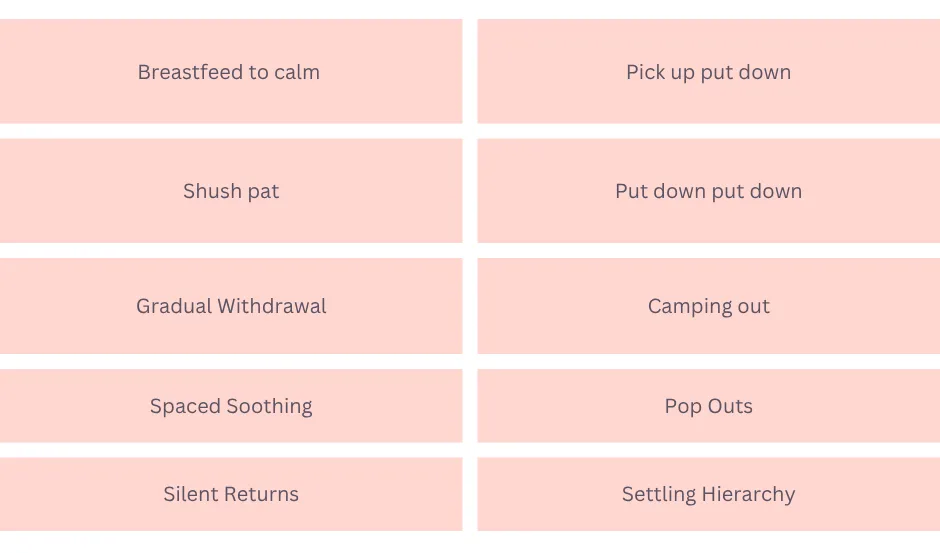
No method is automatically right or wrong.
The best sleep training method is the one that matches your child’s age, temperament, sleep challenge and your ability to stay consistent.
Some babies become more upset with an in-room approach because they can see their parent but cannot fully engage with them. Other babies feel calmer with a gradual presence. Some toddlers need clear boundaries and predictability. Others need more connection before bedtime before boundaries can work well.
This is why personalised sleep support can be helpful. The method needs to fit the child in front of you.
Should you sleep train during a regression?
Sleep regressions often prompt families to start searching for baby sleep training, but it is not always necessary to wait for a regression to completely pass.
Regressions are often linked to development, changing sleep needs, separation anxiety, new physical skills, nap transitions or emotional growth.
Sometimes the regression is not the only issue. It may be revealing that your baby’s routine, awake windows, nap structure or settling approach no longer matches their current stage.
This can happen during:
The 4 Month Sleep Regression
The 8 to 10 Month Sleep Regression
The 12 Month Sleep Regression
The 15 to 18 Month Sleep Regression
The 24 Month Sleep Regression
Sleep training during a regression does not mean ignoring development. It means adjusting support to match what has changed.
In some cases, this may mean pausing big changes for a few days. In other cases, it may mean changing the routine, shifting the settling approach, or adding more consistency because waiting indefinitely is making sleep feel worse.
Sleep training after eight months
Sleep training can absolutely begin after eight months, but the approach often needs to consider more than just sleep timing.
From around eight months onwards, sleep is increasingly influenced by:
Separation anxiety
Object permanence
Crawling, pulling to stand or walking
Emotional development
Nap transitions
Bedtime resistance
Feeding changes
Bigger reactions to change
This is why sleep training after eight months often needs a balance of routine structure, emotional reassurance and clear consistency.
Many families at this stage are navigating the 8 to 10 Month Sleep Regression, the 3 to 2 Nap Transition, or separation anxiety. It is normal for sleep to feel more unsettled during these stages, but that does not mean you cannot make changes.
It simply means the approach may need to be more thoughtful.
Sleep training at twelve months and beyond
Around twelve months, many families begin wondering whether sleep training is still possible.
It absolutely is.
The 12 month stage can bring increased separation anxiety, nap resistance, early walking, bigger emotions and questions around whether it is time to move toward one nap.
Most babies are not ready for the 2 to 1 Nap Transition right at twelve months, but they may begin resisting naps or bedtime during the 12 Month Sleep Regression.
At this age, sleep training may include:
Reviewing two nap routines
Avoiding dropping to one nap too early
Supporting separation anxiety
Adjusting the settling approach
Managing early morning waking
Reviewing milk and solids
Creating more predictable bedtime boundaries
Sleep training at twelve months is not just about bedtime. The full day matters.
Is there such a thing as starting too late?
No. There is no age where it is too late to improve sleep.
Toddlers and older children can still be supported toward more settled sleep, but the approach looks different to infant sleep training.
Toddler sleep support often involves:
Clear bedtime routines
Predictable boundaries
Managing bedtime battles
Supporting fears or separation anxiety
Responding consistently overnight
Reviewing naps and total sleep needs
Using age-appropriate communication
Helping toddlers understand what to expect
Toddlers are more aware, more verbal and more independent, so toddler sleep training often requires more communication, preparation and consistency.
It is still possible. It just needs to be age appropriate.
When sleep training may not be the right first step
Sometimes sleep training is not the first thing I would recommend.
It may be worth reviewing other factors first if your baby:
Is unwell or recovering from illness
Has reflux symptoms, discomfort or suspected pain
Has feeding concerns or is not feeding well
Low weight gain
Snoring
Mouth breathing
Eczema
Blood or mucus in the stool
Frothy stool
These signs do not automatically mean something serious is happening, but they can point to discomfort, feeding challenges, allergies, intolerances, reflux, airway concerns or other underlying factors that may be affecting sleep.
In these cases, it is important to seek appropriate medical or feeding support before focusing on sleep training methods.
Sleep can still improve, but the first step is understanding whether your baby is comfortable, feeding well and medically supported.
Courses that support sleep training at different stages
If you are unsure how to start sleep training or what your baby needs at their age, our sleep courses are designed to give you clear, age-specific guidance.
The 5 to 24 Month Infant Course – supports families through routines, awake windows, regressions, nap transitions, settling approaches and overnight sleep from infancy into toddlerhood.
Infant and Toddler Bundle – gives longer-term support across both baby and toddler sleep, so you can understand what changes as your child grows.
2 to 4 Year Toddler Course – is designed for toddler sleep challenges, including bedtime resistance, fears, parasomnias, boundaries, routines and dropping naps.
Each course is designed to evolve with your child, rather than offering a one-size-fits-all solution.
Need personalised help with sleep training?
If you are unsure when to start sleep training, which sleep training methods are right for your baby, or whether your child is ready, a 30-minute sleep consultation is a great place to start.
We will look at your baby or toddler’s routine, awake windows, naps, feeds, sleep environment, settling, night wakes and your goals, then give you clear next steps tailored to your child.
If sleep feels more complex or unsustainable, our Two Week Sleep Support package includes a personalised sleep plan, a 60-minute consultation and 14 days of weekday support while you make changes.
The Sleepy Little Bubs is based in Melbourne and offers virtual baby and toddler sleep consultations across Australia and worldwide, with in-home sleep support available in Melbourne.
What is the best age to start sleep training?
Many families begin baby sleep training between five and eight months, when sleep pressure, routines and developmental readiness are more established.
However, sleep support can begin earlier or later depending on your baby’s age, sleep challenges and your family’s needs. For younger babies, this usually focuses on sleep education, routines, feeding, sleep environment and realistic expectations rather than formal sleep training.
Do all babies need sleep training?
No. Not every baby needs sleep training.
Some babies naturally develop predictable sleep patterns with time, while others benefit from clearer routines, age-appropriate awake windows, sleep environment changes or adjustments to how sleep support is offered.
Baby sleep training is only one form of sleep support, and whether it is needed depends on your baby’s age, temperament, sleep patterns and what feels sustainable for your family.
How do I know if my baby is ready for sleep training?
Signs your baby may be ready for sleep training can include persistent night waking, short naps, difficulty settling at bedtime or after overnight wakes, or sleep patterns that feel exhausting and unsustainable despite routine adjustments.
Readiness is not about your baby sleeping perfectly. It is about whether your baby is developmentally ready, your routine is age-appropriate, and your current sleep patterns are no longer working for your family.
Can sleep training help with night waking?
Yes. Sleep training often focuses on improving how babies fall asleep and resettle between sleep cycles, which can reduce frequent overnight waking over time.
Should I wait until a sleep regression ends?
Not necessarily. Many regressions reflect developmental changes rather than problems that must fully pass before support begins. Sleep strategies can usually be adjusted to suit these stages.
Is it too late to sleep train a toddler?
No. Toddlers can absolutely be supported toward more settled sleep. The approach typically includes routine consistency, emotional reassurance and clear boundaries.
How long does sleep training take?
Every child is different. Some families see improvement within days, while others experience gradual progress over several weeks depending on age, temperament and consistency.
What if I don’t want to leave my baby to cry?
Sleep support does not need to involve leaving your child alone to cry. Many approaches focus on gradual changes while continuing to offer reassurance and support.
PRODUCTS
INFORMATION
SUPPORT
LEGAL




© Copyright The Sleepy Little Bubs All Rights Reserved.