
8–10 Month Sleep Regression: Signs, Schedule & What Helps



What it is, why it happens, signs to look for, and how to support your baby through the 8, 9 and 10 month sleep regression.
If your baby was sleeping reasonably well and suddenly nights feel more broken, naps become shorter, or settling feels much harder, you are not imagining it.
Between around eight and ten months, many families notice what is commonly referred to as the 8–10 month sleep regression.
This stage can include the 8 month sleep regression, 9 month sleep regression or 10 month sleep regression, depending on your baby’s development, sleep needs and routine. It is often linked to rapid cognitive and emotional development, separation awareness, object permanence, changing sleep pressure and big new skills.
While it can feel intense, it is a very common and developmentally expected stage.
With the right routine, nap structure and settling support, sleep can begin to feel more predictable again.
What is the 8-10 month sleep regression?
A baby sleep regression is a temporary disruption in sleep that often appears during periods of significant developmental change.
During the 8–10 month window, this can show up as frequent night waking, increased distress at bedtime, short naps, early morning waking, or a baby who suddenly needs much more support to settle.
Unlike the 4 month sleep regression, this stage is not usually driven by a permanent sleep cycle change. Instead, it often reflects how much your baby’s brain, body and emotional awareness are developing at once.
Why does the 8-10 month sleep regression happen?
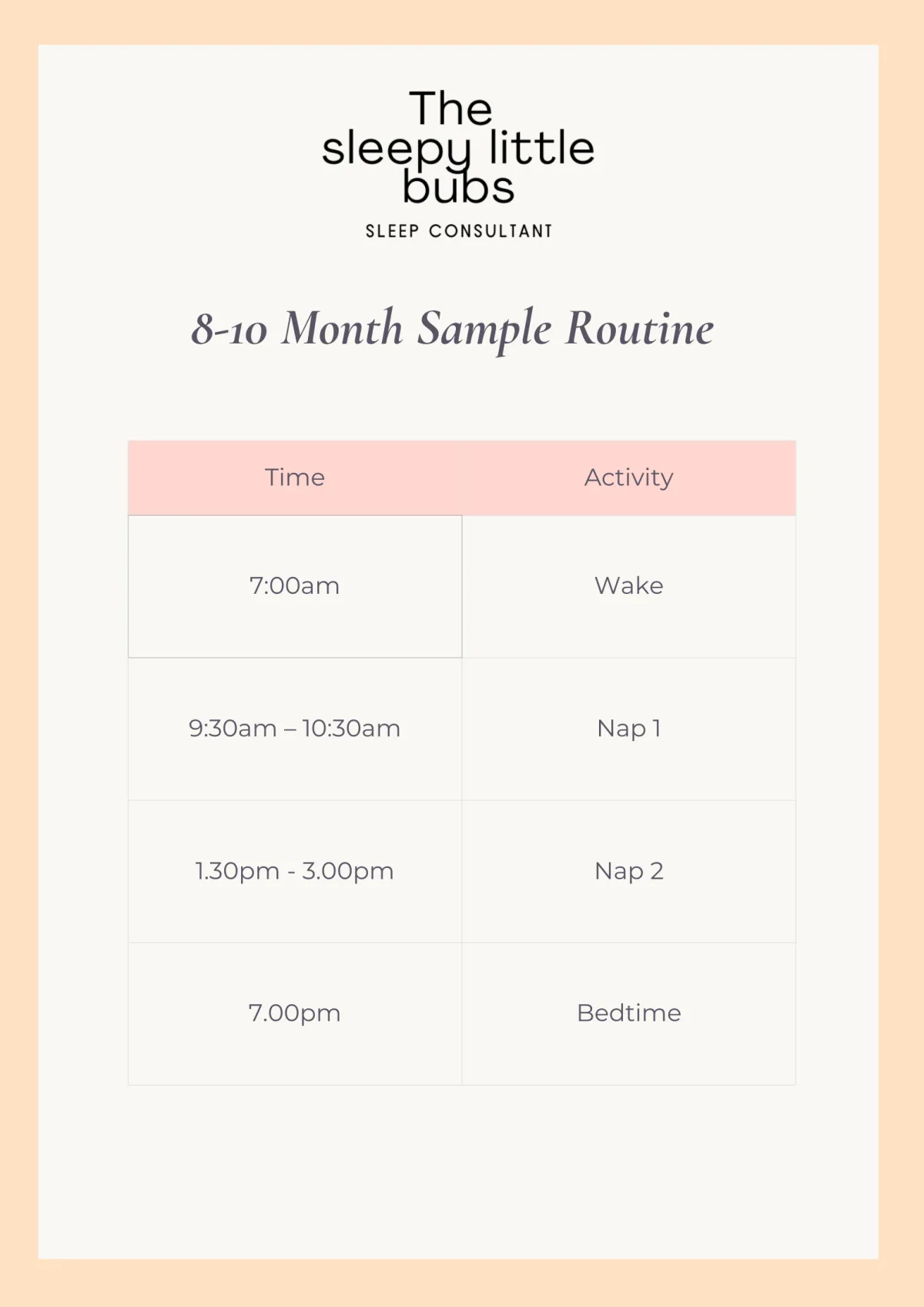
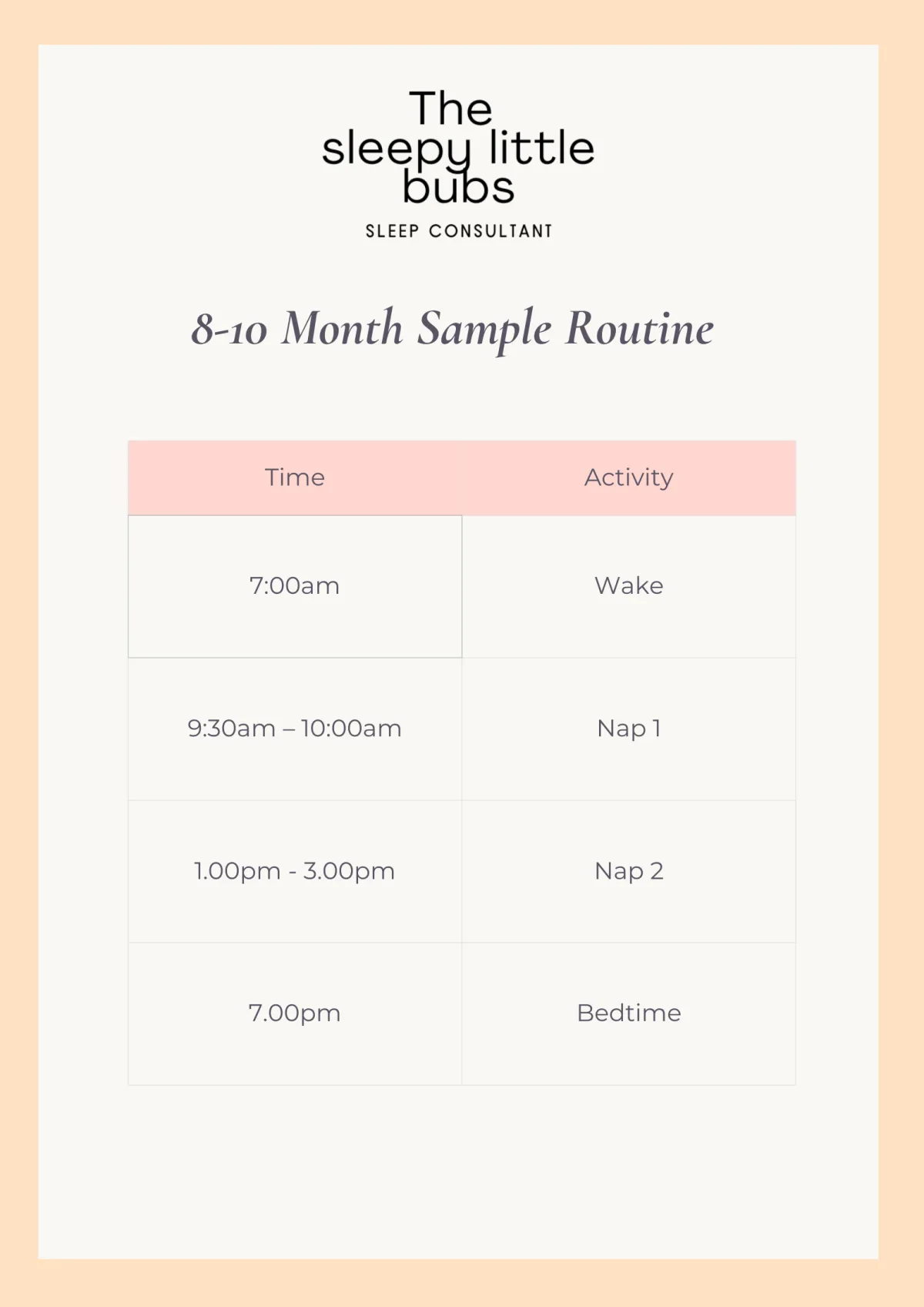
Every baby is different, but most babies between eight and ten months are working well with two naps, consistent awake windows and a predictable bedtime. These sample routines show what an 8 month sleep schedule, 9 month sleep schedule or 10 month sleep schedule can look like when sleep is settling into a two-nap rhythm.
These routines are examples only and are best used as a guide. Your baby’s ideal routine will depend on nap length, morning wake time, overnight sleep, feeding, development and how well they manage awake time.
8–10 Month Sleep Schedule Examples
This routine can work well for babies who take two more evenly balanced naps across the day.
It suits babies who are settled on two naps and managing consistent awake windows, while still allowing flexibility during the 8–10 month sleep regression.
Medium / Medium 8–10 Month Sleep Schedule
Short / Long 8–10 Month Sleep Schedule
This routine works well for babies who take a shorter morning nap and a longer midday nap. It can help protect bedtime while still supporting day sleep during the 8–10 month sleep regression.
The 8–10 month sleep regression is usually driven by a combination of developmental changes, emotional awareness, new skills and shifting sleep needs rather than one single cause.
Object permanence
One of the biggest developmental changes at this age is object permanence.
Your baby now understands that you exist even when they cannot see you.
While this is an important cognitive milestone, it can also make separation feel much harder, particularly at naps, bedtime and overnight wakes.
As a result, your baby may protest when you leave the room, wake overnight calling out for you, or struggle to resettle once they realise you are no longer there.
Increased separation anxiety
Alongside object permanence, separation anxiety often becomes more noticeable during the 8 month sleep regression, 9 month sleep regression and 10 month sleep regression stage.
Your baby may appear more clingy during the day and more unsettled at naps and bedtime, even if settling was previously going well.
This increase in emotional awareness can make baby sleep feel less predictable for a period of time.
New physical skills
Many babies between eight and ten months are crawling, pulling to stand, cruising, sitting, or becoming much more mobile.
These new skills place extra demand on the nervous system and can lead to lighter sleep, more frequent night waking, nap resistance or increased waking while the brain processes everything that is changing.
Changing day sleep needs
Between eight and ten months, most babies are settled on two naps, but sleep pressure continues to evolve.
Short naps or catnapping can reappear if awake windows need adjusting, overnight sleep has become more disrupted, or the day is no longer quite matching your baby’s current needs. This is where reviewing an 8 month sleep schedule can be really helpful.
Some families are also still navigating the tail end of the 3–2 nap transition, which can temporarily affect naps, bedtime and overnight sleep while sleep consolidates.
False starts and lighter sleep
This stage can also bring an increase in false starts, where your baby wakes shortly after being put down at bedtime.
False starts during a baby sleep regression can be linked to overtiredness, undertiredness, separation anxiety, emotional discomfort around bedtime, or a routine that needs adjusting.
They do not always mean your baby is ready to drop a nap. Often, it is a sign that awake windows, naps, bedtime or settling support need to be reviewed.
Signs of a Sleep Regression at 8–10 Months
Common signs include:
Increased night waking
Short or inconsistent naps
Heightened distress when separated
False starts at bedtime
Difficulty resettling overnight
Nap resistance or bedtime battles
Early morning waking
Sleep that suddenly feeds unpredictable
If your baby is waking frequently overnight, it can be helpful to look at the full 24-hour picture rather than focusing only on the night.
During this stage, frequent night waking can be linked to separation anxiety, new skills, nap timing, awake windows, bedtime, feeding patterns or how your baby is supported to sleep.
How long does the 8-10 month sleep regression last?
For many babies, the 8–10 month sleep regression lasts around two to six weeks, which is why it is often referred to as the 8-10 month regression.
How long it lasts will depend on your baby’s development, sleep needs, routine, naps, awake windows and how consistently sleep is supported through this stage.
If sleep disruption continues beyond this period, it may be a sign that your baby’s routine, nap structure, bedtime, feeding patterns or settling approach needs to be reviewed to better match their current needs.
The goal is not to wait it out forever, but to understand what has changed and adjust the routine in a way that supports your baby’s current stage.
How to support sleep during the 8-10 month regression?
Follow an age-appropriate routine
Most babies at this stage are settled on two naps with longer awake windows. Using a realistic 8–10 month sleep routine can help ensure your baby is getting enough awake time without becoming overtired.
If your baby has not fully moved through the 3–2 nap transition, this may also be contributing to short naps, false starts, night waking or bedtime becoming harder. Some babies still need a brief third nap for a short period, while others are ready for two more predictable naps and an earlier bedtime while they adjust.
Adjust settling techniques if needed
Because separation anxiety and object permanence are so prominent at this age, some babies need a shift in settling approach. Techniques that worked well earlier may suddenly feel too abrupt.
Supporting your baby with a more gradual presence, additional reassurance, or a slower withdrawal can help them feel safe while still working toward falling asleep in a way that suits this stage.
Support connection around sleep times
Extending your wind down routine, offering extra connection before bed, and keeping sleep cues consistent can all help reduce distress linked to separation anxiety.
Be patient with naps
If naps shorten temporarily, this does not mean progress is lost. Catnapping is common during this stage and usually improves once sleep pressure, routines and emotional regulation settle again.
Should you make changes during the 8-10 month regression?
This stage is not about forcing change or pushing independence before your baby is ready. It is about recognising that your baby’s emotional awareness, cognitive development, sleep needs and routine may have shifted.
Small, age-appropriate changes can make a significant difference during this phase. This might include reviewing awake windows, protecting naps, adjusting bedtime, supporting separation anxiety, or choosing a settling approach that better suits your baby’s current stage.
The goal is not to change everything at once. It is to understand what has changed, make thoughtful adjustments, and support your baby back into a more predictable rhythm.
Looking ahead
Sleep continues to evolve beyond the 8–10 month sleep regression, with future regressions, nap transitions and emotional milestones as your baby moves into toddlerhood.
Having guidance that grows with your child can make these stages feel far less overwhelming.
The 5–24 Month Infant Sleep Course provides age-specific baby sleep support through routines, naps, night waking, regressions and nap transitions. The Infant and Toddler Bundle offers longer-term guidance right through the early years, so you always know what to expect and how to respond with confidence.
Need help through the 8–10 month sleep regression?
If frequent night waking, short naps, false starts, early rising or separation anxiety are making sleep feel unpredictable again, personalised support can help.
A 30-minute sleep consultation is ideal if you need targeted advice, routine adjustments and clear next steps tailored to your baby’s current stage.
For more in-depth support, our Two Week Sleep Support package includes a personalised sleep plan, a 60-minute consultation and 14 days of support to help you work through sleep challenges with guidance.
The Sleepy Little Bubs is based in Melbourne and offers virtual baby and toddler sleep consultations across Australia and worldwide, with in-home sleep support available in Melbourne.
Whether you need quick clarity or ongoing support, we’re here to help.

Eva Beke
Certified Paediatric Sleep Consultant
Founder The Sleepy Little Bubs
I’m Eva Beke, a certified baby and toddler sleep consultant and founder of The Sleepy Little Bubs, supporting families across Australia and the world with evidence based baby and toddler sleep support.
My approach is realistic, supportive, and designed to evolve as your child grows, so you’re not just getting help for today, but confidence moving forward.
CLIENT STORIES
Real Families. Real Rest.

"I actually can't believe how much your infant course has changed my little ones sleep... and in such a short amount of time. Thank you!"
- Sofija


"Ok, so here I am thinking this is just another "ohh most comprehensive" guide blah blah blah... wowza... the toddler course literally has everything, and I can't even tell you how many times I have referred back to it. Best money spend on sleep so far"
- Christina

"Hey I just wanted to let you know, I purchased your toddler course and within days we've gone from bed sharing and multiple wake ups to him sleeping in his own bed and sleeping through the night. What is this magic?"
- Lisa
PRODUCTS
INFORMATION
SUPPORT
LEGAL




© Copyright The Sleepy Little Bubs All Rights Reserved.